
|
Channeling emotions and finding release in movement Long before words, there was movement. As kids, we didn’t sit with our emotions - we flowed with instinctive expression. As adults, we have lost that connection replacing movement with (over)thinking, structure, responsibilities. This deeply felt post by Navatman member, Dolonchapa Chakraborty, explores why movement is not a luxury but rather the very core of how we process emotion. The body remembers what the mind tends to forget.
Childhood: Before emotion had language Hobbies and extracurriculars: Two words that mean something very different when you hear them as a child versus when you live them as an adult. As a kid, especially if you grew up in an environment where structure was non-negotiable, extracurriculars weren’t optional. They weren’t something you “fit in when you had time.” You made time. Period. And more than that, they weren’t just activities. They were movement. Expression. A way for emotion, energy, and discipline to have somewhere to go. I still remember my dance teacher once looking at me and saying, very simply: Did you brush your teeth? Yes. Did you eat breakfast? Yes. Then why didn’t you practice dance? For context, I had an SAT-equivalent math test that day. But in that moment, I remember feeling something very specific: not rebellion, not anger — just shame. Like I had misunderstood what was supposed to matter more. And I never missed another class again. That’s the part that stays with me. Because looking back, what I was learning — without having the language for it — was something simple but physical: emotion doesn’t stay still. And for a long time, the body was where it went. You ran, you danced, you played, you showed up. With less inhibition and a smaller vocabulary, emotion had a direct route out — through movement — before it ever became something you could explain. Adulthood: When everything became structured Then you grow up. And everything becomes a hobby, or a side gig, or “something for your mental health,” or a passion project you get to only when life allows it. These are all very adult words. Negotiated words. Words that sit behind the “real” work of the day job.  Now, I actually like what I do. I’ve maybe had six months in my life where I didn’t. But even when you enjoy your work, adulthood often turns everything into structure and deadlines. You move from one deliverable to the next, one meeting to the next, one fire drill to the next. And slowly, the space where emotion used to move freely starts getting compressed into whatever time is left. So creativity becomes something you schedule. Not something you inhabit. I’ve been thinking about this a lot recently — especially with AI, automation, and agents taking over more of the execution layer of work. Less time formatting slides, aligning boxes, fixing decks. In theory, that should create space. But space is not the same as expression. Because if the body is not part of the process anymore, then what fills that space is often more thinking. More optimizing. More managing. And emotion — unless it is given somewhere to go — doesn’t disappear. It just stays in quieter, unprocessed ways. The body remembers first Neuroscience increasingly supports what many people intuitively already feel: emotional states are not purely mental events. They are physiological. The autonomic nervous system shifts heart rate, breathing patterns, muscle tension, and hormonal activity in response to stress, grief, anger, or anxiety. The mind may interpret the experience, but the body carries it first. This is why emotion can feel stuck — not because we haven’t thought enough about it, but because thinking alone does not complete the cycle.  A tight chest before you’ve named why. A heaviness in the shoulders with no clear origin. A restlessness that doesn’t resolve through thinking harder, planning better, or explaining it more logically. And yet, we are often taught — directly or indirectly — that emotions are something to understand first. Name them. Analyze them. Reframe them. Solve them. But not all emotional experiences begin in language. Some begin in the body, long before they become words. This is why emotion feels embodied even before it is understood. Because the body doesn’t wait for language. It reacts first. Movement as emotional completion Movement is one of the most direct ways the nervous system regulates itself. Not in a symbolic sense, but a biological one. Yoga shifts breathing patterns. Shaking releases muscular tension. Dancing integrates breath, coordination, and sensory input in a way that changes internal arousal states. Even simple repetitive motion — walking, pacing, stretching — helps the body move from activation toward regulation. But most of this is already familiar, even without explanation. A walk that unknots a thought you couldn’t solve sitting still. Dancing alone in a room until something shifts without explanation. Running until the noise in your head finally softens. In these moments, movement is not performance or exercise. It is translation — turning something internal and dense into something physical that can pass through. The body is not separate from emotional life. It is where emotional life unfolds.  And yet modern life pulls us away from that. We are trained to sit through discomfort, think our way through tension, optimize response instead of inhabiting sensation. Even rest becomes structured. Even recovery becomes another task. So emotion doesn’t disappear. It accumulates differently — less as rupture, more as noise. A subtle distance from the body. A sense of being more in thought than in experience. Movement interrupts that loop: not by explaining emotion, but by moving it. By restoring circulation — of breath, attention, and sensation. You don’t need to do it correctly. There is no method that matters more than the act itself. Often it is something small: a change in pace, a shift in rhythm, a return from interpretation to sensation. Because movement is not something added to emotional processing. It is part of the processing itself. Emotion was never meant to stay in thought alone. And the body was never meant to be separate from how we feel. We tend to think of movement as something that comes after emotion — after clarity, after readiness, after control. But more often, it is what makes feeling possible in the first place. In childhood, emotion moved before it had language. In adulthood, language arrives first — and movement is forgotten. So maybe the question isn’t how to add more hobbies, or how to optimize creativity, or how to fit “self-expression” into a full calendar. Maybe it’s simpler than that. Maybe it’s remembering what we already knew before we had language for it: Emotion doesn’t stay still. It moves. And when it doesn’t, the body holds it until we finally do. Movement was never separate from emotion. It was where emotion went. And movement is not what we do after life is “handled”. It is one of the ways life gets “handled” in the first place. Be Moved We invite you to Baila Society x Navatman Season 2026! Our June program brings together Salsa, Latin Hustle, Bharatanatyam, and Kathak under one original score, performed live, only in NYC. For one weekend, be part of a grassroots movement breaking barriers, connecting communities. Watch a clip from Roots of Resilience. About us
Navatman and Baila Society joined forces in 2024 for a uniquely New York City experience: a place where two women-led arts organizations based in the cultural traditions of Afro-Latinx arts (Salsa, Latin Hustle, Afro-Cuban) and Indian arts (Bharatanatyam, Kathak, Hindustani and Carnatic music) come together. In this shared space, we explore how the force of artists and students working together can promote, define, and create a sense of stability and strength, joy and love within communities at large - particularly through artistic endeavors. Written by Dolonchapa Chakraborty
1 Comment
Philosophy sessions drive our work
“If you wish to make an apple pie from scratch, you must first invent the universe.“ - Carl Sagan This is, sort of, how we approach our productions too. One would think creating a show is just pick a theme, make music, make choreography, logistics, 1-2-3 and done! Not quite how we want it here. For us, the very first rehearsal is an open discussion, a philosophy session. There is something radical about a group of dancers sitting still in a circle. Not moving but thinking, speaking, listening, digging deep. Before we explore movement and formations, we must meditate for ourselves - individually and collectively - why we must do this.  How do we build new ideas around art? How do we truly create together to serve a community instead of just an audience? How do we empower ourselves to be more available to those around us; to participate in the world in a way that doesn’t feel defeated? What does this look like, albeit differently, for each of us? We sit with the complexity rather than try and simplify it. We embrace the uncertainty. We hope that this keeps our work honest - something for you to not just watch and enjoy but to experience. These philosophy sessions are the seed for you to connect beyond the stage; to reflect, question, and participate. The dialogue evolves over multiple conversations to bring us closer together. We find that we are not alone in our joys and traumas. We take up more space. We find comfort in the acceptance and belonging that we have with each other and of our shared purpose. These are not vague musings. They are a grassroots movement to inspire movement! So that we are not merely performing, but embodying our lived realities inside and out. About this post This post is part of an ongoing series reflecting on cross-cultural community, ancestral memory, and the ways dance carries both joy and resistance. These stories are not separate from the work on stage. They ARE the work. When the Sun Rises brings these threads together in a live experience. Join us June 26–28 at Ailey Theater. Be part of what we are building. About us
Navatman and Baila Society joined forces in 2024 for a uniquely New York City experience: a place where two women-led arts organizations based in the cultural traditions of Afro-Latinx arts (Salsa, Latin Hustle, Afro-Cuban) and Indian arts (Bharatanatyam, Kathak, Hindustani and Carnatic music) come together. In this shared space, we explore how the force of artists and students working together can promote, define, and create a sense of stability and strength, joy and love within communities at large - particularly through artistic endeavors. This post is part of a series rendering our creative process. Written by Lavanya Jagirdhar and Aashutosh Mukerji Use daily practice to cope and center yourself. Some days feel too much. Perhaps the world is racing to catastrophe. Or the daily rut is suffocating. Or change is overwhelming. Or apathy has drowned out any hope. Things are out of control and there is nothing we can do. So how do we endure? We as artists (yes, even you, the artist in training!) turn to riyaaz, our daily practice. Practice is not meant to be solely for improvement, nor should it feel like an imposition by the teacher. As Sahi says in this clip, it can be an effective way to ground and release emotion. 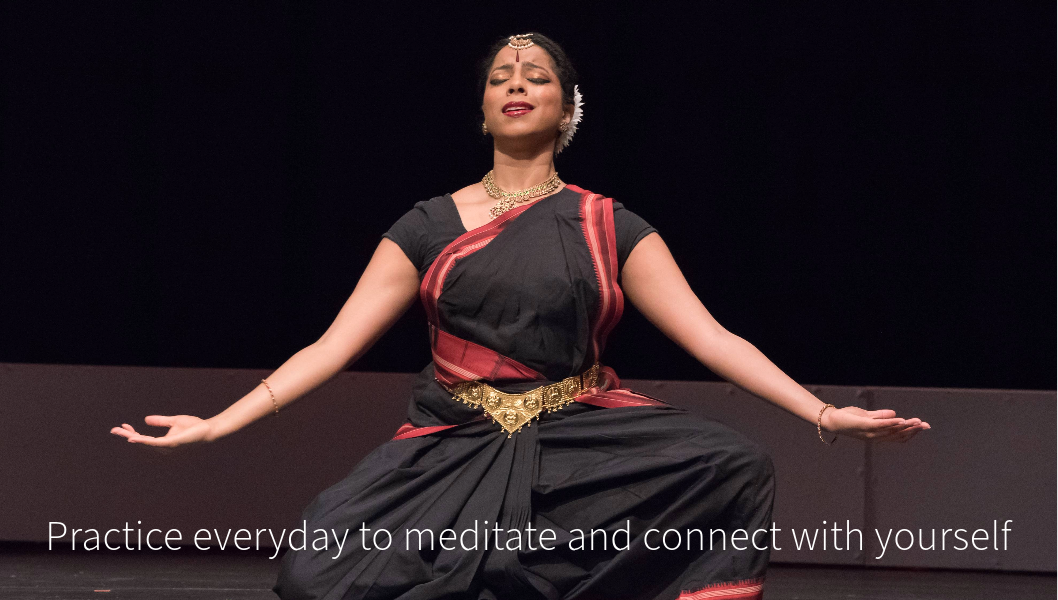 There is an artist in each and every one of us. Your art is an intrinsic part of your being; it can bring you resilience, calm, strength, and contentment.
Whichever your chosen art form, channel it everyday - even for a few minutes - to find peace, release, and self-love. Watch the full video of how riyaaz can help your mental health: https://navatmanvideobroadcasting.uscreen.io/programs/mentalhealthandpractice Available beginner courses: Take 30 days to explore the basics of Kathak: https://navatmanvideobroadcasting.uscreen.io/pages/kathak30daychallenge Take 30 days to explore the basics of Bharatanatyam: https://navatmanvideobroadcasting.uscreen.io/pages/bharatanatyam30daychallenge Absolute Beginner Bharatanatyam Course Absolute Beginner Kathak Course Bharatanatyam Thattadavus course Explore the catalog Practice makes perfectly present in the moment. -Lavanya Jagirdhar Dancing is incredible for our body, mind, and spirit - especially in our twilight years. There is growing evidence to support the therapeutic effect of dance as we age. From muscle function and cognitive control to overall mood and quality of life, dancing elevates our wellbeing in many ways even compared to other forms of physical activities. If you're reading this, you already know it's fun! But did you know it can also battle neurodegenerative conditions, create new neural connections, keep cognitive mobility and function operating at a high level, manage muscular degeneration, help with posture, and more? On top of this, mix pleasure and benefit and you have a recipe to joyfully keep your quality of life high without the intense pressure of other, less exciting activities. According to these articles from Harvard Medical School [1] and Scientific American [2]: Music stimulates our brains’ reward centers. Coordinated movements do too. So dancing - combining music and movement - constitutes a “pleasure double play” for our brains. The second article explores in depth why... So it is no surprise that dance and music are being increasingly studied as tools to prevent, manage, or improve neurodegenerative conditions in aging populations. How it works: Neurodegenerative disorders are associated with the damage and death of nerve cells in the brain - Parkinson’s and Alzheimer’s being the most commonly known ones. Parkinson’s disease (PD) primarily causes shaking, stiffness, issues with posture and balance, and difficulty walking and talking over time - manifesting from regions of the brain associated with movement. Alzheimer’s disease (AD) is a type of dementia that affects memory, thinking, language, and behavior; eventually impacting the ability to tackle simple tasks. It starts from regions of the brain associated with memory, then spreads to other areas. So how can we challenge these areas of the brain and promote healthy neural connections? By dancing, of course! This systematic review from the National Institutes of Health [3] database concluded that dancing “substantially improved the global cognitive function, memory and executive function” for those having mild cognitive impairment, and “remarkably improved general disease condition, balance, and gait” for those having Parkinson’s. Watch PD patients find joy through dance in India in this BBC clip [4]. Or check out the sheer number of “Dance for PD”, “Choir for AD” type classes inspiring hope everywhere, even on zoom. This study published in the New England Journal of Medicine [5] found that while leisure activities reduced the risk of dementia... 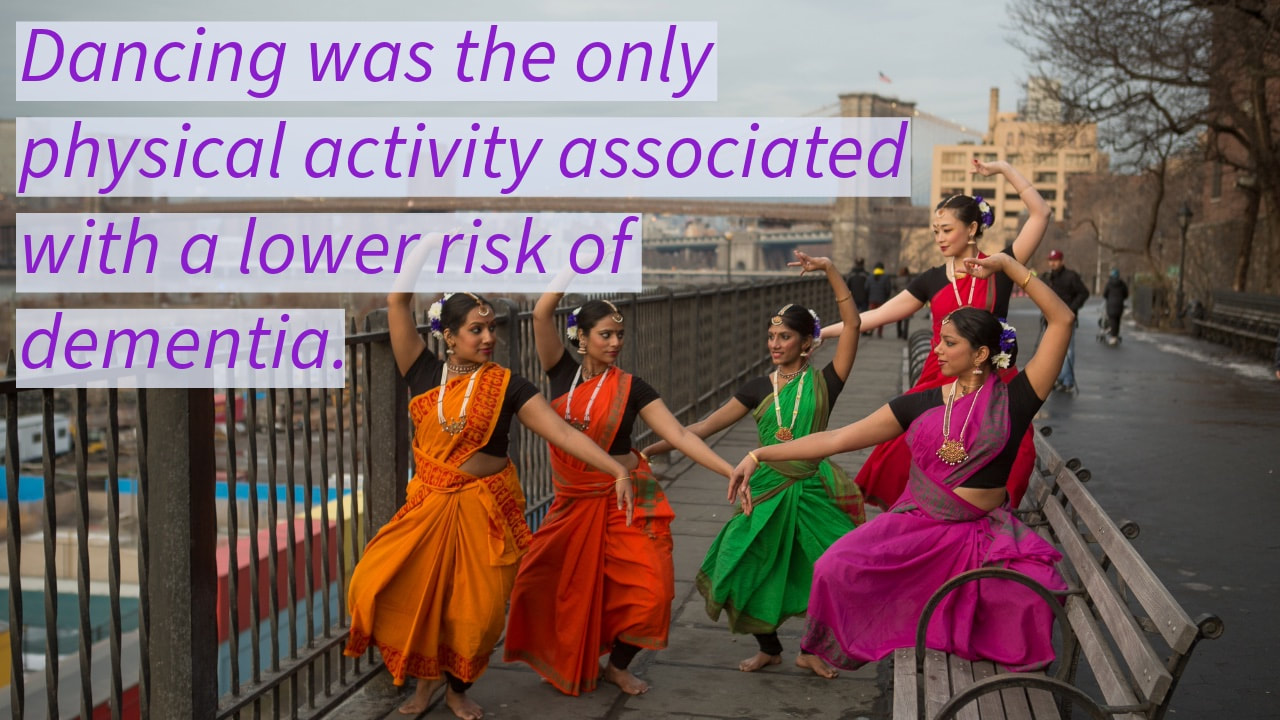 Our bias might show a little when we proudly state that Indian dance is the icing on this awesomeness cake. The inherent structure and philosophy of these art forms - and how we approach learning them at Navatman - afford plentiful benefits. Cognitive gains from the way we learn our basic bants/adavus and progress into complex choreography with lots of rhythmic variation. Muscular gains from how we initiate proper posture/conditioning into muscle memory and incorporate our hastas/bhedas/charis with varieties of cross-training into repetitive practice. Cardiovascular gains from maintaining technique in third/fourth speeds and working up to lengthy repertoires. Psychological gains from abhinaya meditations and practice discipline. Social gains from group classes and performance camaraderie. Don’t take our word for it, read unique perspectives here [6] and here [7] about Bharatanatyam on the brain. 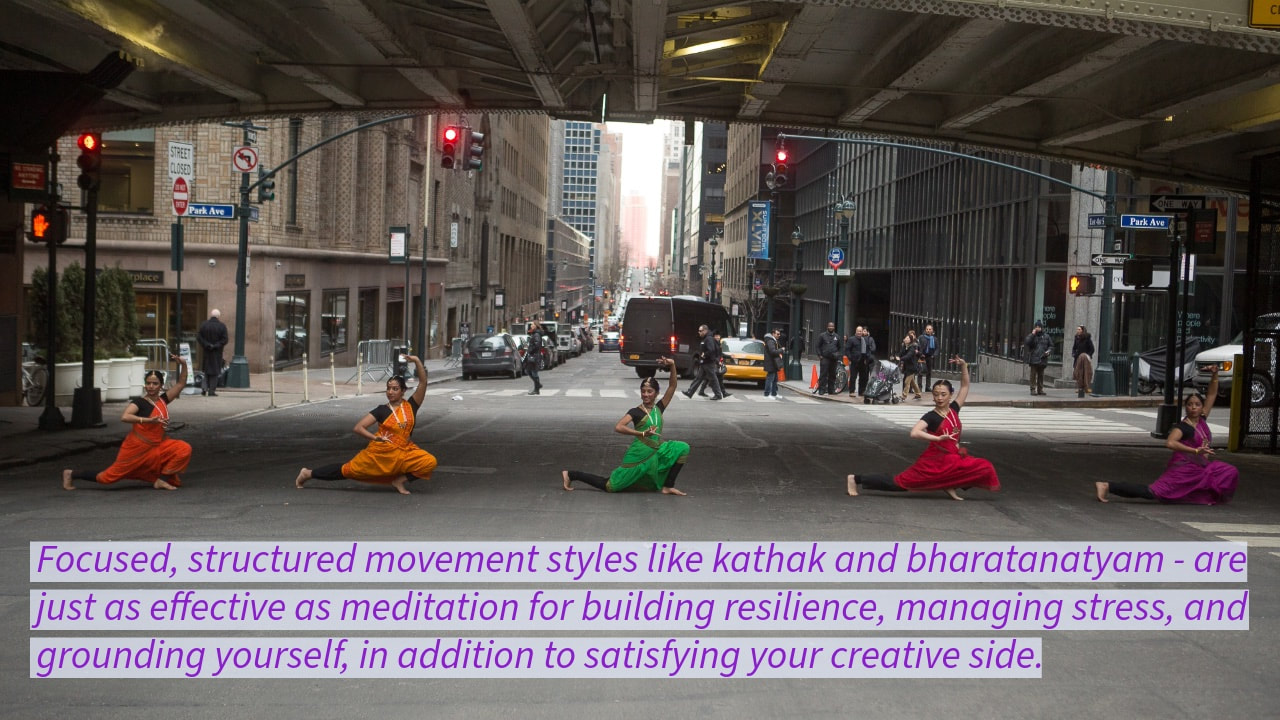 So what are you waiting for? Take advice from the CDC [8] and get moving:References:
[1] Scott Edwards. “Dancing and the brain”. Harvard Medical School, 2015. https://hms.harvard.edu/news-events/publications-archive/brain/dancing-brain [2] John Krakauer. “Why do we like to dance—And move to the beat?”. Scientific American, 2008. https://www.scientificamerican.com/article/experts-dance/ [3] Cheng-Cheng Wu, et al. “Dance movement therapy for neurodegenerative diseases: A systematic review”. NIH, 2022. https://www.ncbi.nlm.nih.gov/pmc/articles/PMC9394857/ [4] Omkar Karambelkar and Nitin Nagarkar. “Parkinson’s disease: The patients finding joy through dance in India”. BBC India, 2023. https://www.bbc.com/news/av/world-asia-india-65421777 [5] Joe Verghese et al. “Leisure activities and the risk of dementia in the elderly”. New England Journal of Medicine, 2003. https://www.nejm.org/doi/full/10.1056/NEJMoa022252 [6] Samiksha Sivan. “Neurobiology of Bharatanatyam: Dancing with your brain”. 2020. https://medium.com/@sammy.rafa/neurobiology-of-bharatanatyam-dancing-with-your-brain-b0c67580e009 [7] “How does dance, specifically Bharathanatyam affect brain development”. Business Bliss Consultants FZE, 2018. https://ukdiss.com/examples/dance-affect-brain-development.php [8] “Dance your way to better brain health”. Centers for Disease Control and Prevention, 2018. https://www.cdc.gov/aging/publications/features/alzheimers-and-exercise.html Written by Lavanya Jagirdhar When I first started Navatman with Sridhar Shanmugam, ours - and our fellow artists would often wonder, why exactly is it that no one wants to pay for the arts?
We’d cite common examples: our tickets cost less than ordering a meal in! You spend more than that 2 drinks in a night out in Manhattan! Your cab fare is less! Yet... People would argue with us: “you can see other great artists at cheaper tickets”. This is absolutely true...but those other artists were also struggling. The arts world was (and still is) facing downsizing audiences. It can sometimes feel like a battle to the bottom in terms of pricing to try to get patrons to sit in seats. It became painfully clear to us that these systems just weren’t working for anyone (and still aren’t). So, it was our goal at the end of the day to change how we valued and paid for the arts. We started with Drive East many years back. I remember the first year we said tickets would cost $25 - $35 for certain artists and how many people told us we were crazy via email, phone, and otherwise. This was a time when most Indian artistic performances would never charge above $20 in NYC. I remember how as a team we went back and forth on arguing on the price. Was it too much? Would we be shooting ourselves in the foot? We tentatively placed artists who had great followings at $50. And it worked. People grumbled, but tickets sold at an unexpected rate even given the pricing. Suddenly, the next year, it was just expected that we would charge this much… We never told anyone this, but we began to actively try to raise the price of arts presentations to get people beyond their inherent biases - (the funny part is, that these prices still do not cover the cost of presenting them). But it didn’t matter - because this kind of price valuation is important in so many contexts from building equality through perception and making sure that we are creating a sustainable economy for Indian arts moving forward. Now, we see impacts beyond our organization. We passed on the word to other artists and organizers, through late night conversations and Drive East trainings, and I could only hope we were emboldening other artists and organizers to think differently about how they could price themselves and they would relay back to us about how our steps forward helped them push differently in their own economies back home. By valuing arts - and Indian arts, at that - to prices equivalent to what we pay for other services and projects in the world around us, we not only change perceptions on valuation of the arts, but also battle inherent biases that surround these values.
Why we call the Mahabharata “a reclamation” The other day, a few patrons asked us why our rendition was so “modern”. How could we look at the Mahabharata through the lenses of gender and caste? Were we not disrupting the traditions? Another patron raised concerns about retelling a story that has been used to oppress people in India in the past. Would the retelling stoke these fires again? It is, for exactly these reasons, for those who believe that the Mahabharata can only be seen through a particular interpretation or lens - that we are doing this work. An oral tradition that became literature that has enraptured South Asia for ages, it is time we gave the Mahabharata far more credit - the conversations we are having right now about these topics are written word for word in the Mahabharata. Bhishma speaks of equality in the Bhishma parva. Duryodhana speaks of unfair behavior and privilege when referring to the Pandavas. Jarasandha, Sisupala and other great kings argue over the dangers of breaking traditions while others oppose their inability to see into the future. Ultimately, the Mahabharata is an incredible story of humanity and its flaws. In the books we read, translations of the critical edition (a compilation and amalgamation of the thousands of stories of the Mahabharata) taught us the beauty of all the pains of being human. It teaches us that one can be a guru, a deeply respected teacher, and make incomprehensible, ugly decisions (Ekalavya’s thumb) - it teaches us that the best among us can be overcome by emotions that cause them to utilize their privileges in unfair advantages (Arjuna when he first meets Karna, Karna’s demand to disrobe Draupadi) - it teaches us that too much ambition can cause wars (Duryodhana). The Mahabharata teaches us there are two sides to every story. It does not teach us only a particular type of narrative, a particular type of morality. In some ways, we are not rewriting or re-envisioning the Mahabharata. We didn’t need to. The story was already there...we are merely pulling the story together to pass down to a different generation. One that deserves to hear it from different perspectives. - Sahasra Sambamoorthi Dear students,
I am writing to you as connoisseurs, lovers, and practitioners of this ancient form of arts we get to call ours: whether it be kathak, bharatanatyam, odissi or any other dance, Hindustani or Carnatic vocals or instrumental. Today is your day to open up and learn something new that I think we are all ready to hear, one I think is time to delve into as we launch into Navatman's largest endeavor to date. All of you have been individually invited to Navatman’s Mahabharata. I know many are excited. But some are still on the fence, and others are probably thinking about things like time and price or are consumed by the business of the world around us. Navatman’s Mahabharata, hopefully, as you all know, is a fairly historic moment for our organisation. It is, as far as we know, the first feature film told from the unique style of storytelling Navatman has been working within for the past few years: one of Indian arts and spoken English verses, and one of a handful of feature films out there about the full Mahabharata epic. The Mahabharata is one of the longest and oldest stories in humanity. If you only know of it marginally, and/or are a student of Indian arts, there is really no reason to miss this event. But I think it’s time to dig into this - as someone who has been watching this back and forth for over 30 years, I have seen students pan back and forth over things like time, energy, space, and money. I and various teachers have wondered: what does this really mean? If those who claim to love the form the most - our own students - do not have time to witness and be part of these moments, who will? Honestly, if this was not embedded into a larger power struggle, one where you may not even realize you are a part of, I would never bother to send this email. But I think it’s time we as students, practitioners, artists, realize the larger picture at hand: What we love and don’t love in this world is colored through the effects of colonialism, and how we watch Indian classical arts is deeply embedded within this. Now, before you run out the door, saying “Sahi’s lost her marbles,” I have spent many years researching this and almost all the reasons a student gives me as to why they cannot watch a show (or sometimes even look at me uncomfortably as I ask if they are going to a show) are related back to the statement above. For instance: “I’m not sure I/my friends/my family will like this [classical] show.” This is a direct correlation of the many years of British rule over India and inherent effects of different cultural perceptions about our space. One where Indian culture is considered “uncool” or “backwards”. If you’ve ever had someone make fun of your lunch growing up, your outfit, your language, or more, this is a much larger, deeper extension of that. How? What we enjoy listening to is mostly informed by how our brain processes memories and information, and a large chunk of that is how you experienced Indian classical dance/music growing up. If it was an environment where people resisted it, because it was “boring”, “they didn’t understand it”, or “I prefer modern and ballet”, this was because for 100-200 years, cultures with more power told us we were not beautiful, our food was too spicy, our traditions too backwards. Do not forget: our art forms were almost eliminated - especially dance - in the mid 1900s. The British pushed to eliminate the roots of practices like bharatanatyam and so India’s independence movement began to be tied with the Idea of nationalism to revitalize it (which is why bharatanatyam in particular is so popular globally today). In fact, the British were so good at pushing this concept on us: that Indian classical dance forms were “uncouth” - that dance was considered more unsavory to learn than music for the generation who grew up in the 1960s - after independence. If British rule had continued, we may not even have some of our classical art forms today. I'm sure some of you are saying: “But I do love Indian dance and music! I love Bollywood!” We at Navatman love Bollywood too - but Bollywood is an art form born of assimilation: one that mixes sounds we are familiar with - “Western” sounds, beats, etc with traditional sounds which is why we often prefer it to art forms like kathak, bharatnatyam, and carnatic and hindustani music. It plays right into the idea that our cultural sounds and spaces need tamping down to be easier to understand and enjoy. Others counter with: “The price is too high”: if you’re willing to pay higher ticket prices for the ballet, modern dance, the symphony etc, consider if you would pay the equivalent amount to an Indian arts show. You probably pay more for a night out at dinner and sometimes your takeout order: so why, suddenly, is a $50 ticket “too expensive”? “I don’t have time” - We know this gets pushed to the bottom of the list, but we are hoping that as practitioners we are now beginning to understand the importance of peeling back some of our biases and being part of changes that need to be made for this work to continue. As you grow as a student, you are also part of the artists and families who will bring these art forms to the next generation. Whether a beginner or professional, it is up to us to learn more. These ideas and traditions are not really spoken about in schools in India, where the British syllabus continues to dictate what we learn and how we learn even on home turf. For instance, the Mahabharata, the largest epic in the world, 2000 years of age, a living tradition that weaves its way significantly through South Asia is not considered literature to be studied. So then, who else is left to do the work? It is us. It is the students, the practitioners, the families. To take it forward, it is on us to see our arts differently, to share it, to understand it more deeply and to cherish it beyond the stage. So, hopefully, this starts to peel some layers. There will be many more conversations in the weeks to come, I’m sure, and if you have any questions, feel free to ask. I will happily continue talking or writing about this series and answer any and all thoughts you may have. Warmly, Sahasra Sambamoorthi Co-President, Navatman Navatman's school started over 10 years ago, with the mission to help nurture an individual's journey in the classical arts. Since then, we've grown to host a community of over 500 students who have joined us at various points of their journey to fulfill their passion for the Indian arts. Joining our community is valuable in a few key ways:
Our community is important to us, and we strive to deliver on the value we see in the Indian arts. Join us wherever you are in your journey: we're happy to have you! The relationship between a teacher (guru) and a student (shishya) is critical to establishing a good learning environment. Finding a good teacher makes a remarkable difference in the student grasping the concept easily.
As you begin your journey in something new, here are a few tips to keep in mind as you choose the teacher that meets your needs:
Looking back on the past several months of quarantine, I realized all the new things I learned online: how to oil paint, how to cut my own hair, an unnecessary amount of tiktok dances, and of course, the best way to bake banana bread!
So when Navatman offered fall classes online, I jumped at the opportunity to keep learning new things. This fall, I started Odissi for the first time. Admittedly, I was a bit nervous about my ability to learn something completely new to me. But after my first class with my teacher, Sri Thina, I knew I was in safe hands. Navatman's commitment to teaching Indian Classical Arts, despite the challenges presented by the pandemic, is remarkable. The teachers are experienced both in their craft and teaching online. Each student is given individualized feedback, on-par with being in-person: from finding the different stances to learning how to isolate my torso movements, I found myself slowly but surely grasping the basics of Odissi. And thanks to Sri Thina, I feel great about learning at a pace that matches my beginner level, ensuring I learn the art form slowly and properly online. So this fall, I'm very excited to add something new and different to my list of accomplishments during the pandemic. I look forward to my Thursday classes and can't wait to grow as an Odissi dancer! Drive East has become one of Navatman’s well-loved traditions. It centers around art, community, joy, and intimacy by showcasing myriad forms of music and dance. Drive East has garnered enthusiastic reviews from journalists and critics, patrons and pupils – it conjures a sense of familiarity and warmth. This week-long festival, which was born in New York City and expanded to San Francisco, is ignited by the core team at Navatman and fueled further by the multitudes of artists who perform, patrons who attend, admirers who tell their friends and family. Drive East creates a platform for the Indian Classical arts because it has always been about the people.
I’ll never forget volunteering for my first Drive East at Dixon Place in 2018. Artists from all over the world gathered at the artist hub to engage and create. The hallways were abuzz with conversation. I was in awe of the energy in this place – lively and warm like an outdoor festival yet tingling with mystery and excitement like when the curtain goes up. It shattered my impression of professional art events. No posh airs? No standoffishness? Just a fresh, inviting space for artists, curators, you, and me to come together in celebration for our love of the performing arts. All the tumult in the world right now has upended normalcy in the performing arts. A performer’s “office” is now a recording booth, sabha, or dance studio. Navatman has adapted too, with our online platform for school semesters, private lessons, masterclasses, Nuance classes, and live stream performances. Given this existential transformation, we wondered, “What is the fate of Drive East?” We realized that although the world has transformed, some things haven’t: Musicians, dancers, patrons, children need to manifest their love for art. We need a shared respite with our community. We need an oasis of intimacy between artist and audience. We need sanctuary. |
AuthorsPriya Narayan Archives
October 2026
Categories |
 RSS Feed
|
Email: [email protected]
Address: 38W 32nd street #300 3rd floor New York NY 10001 We do not have a phone :) please email us |